Rudolph Valentino's net worth is best estimated at around $500,000 at the time of his death in 1926, with a realistic range of $200,000 to $1 million. No estate figure was ever officially published, and the number is genuinely uncertain in a way most modern celebrity estimates are not: Valentino was earning a then-enormous $10,000-a-week film contract with a percentage of profits when he died, yet his Beverly Hills mansion, Falcon Lair, was auctioned off within months of his death for less than he paid for it, specifically to help settle his debts. His fame and his fortune were not the same thing.
August 23, 2026 marks 100 years since Valentino died in New York at age 31, an event that triggered some of the most extreme public mourning in Hollywood history. Known as the "Great Lover" of silent film, he starred in The Sheik, Blood and Sand, and The Four Horsemen of the Apocalypse, and remains one of the defining sex symbols of the 1920s a century later.
Quick Facts
| Full Name | Rodolfo Guglielmi (professionally, Rudolph Valentino) |
| Born | May 6, 1895, Castellaneta, Apulia, Italy |
| Died | August 23, 1926 (age 31), New York City; peritonitis following surgery for a ruptured ulcer and appendicitis |
| Known For | The Sheik (1921), Blood and Sand (1922), The Four Horsemen of the Apocalypse (1921) |
| Final Contract | $10,000 per week plus profit percentage, United Artists, 1926 |
| Spouses | Jean Acker (1919-1922); Natacha Rambova (1923-1926) |
| Home | Falcon Lair, Beverly Hills, bought for $175,000 in 1925; auctioned for $145,000 after his death |
| Estimated Net Worth | About $500,000 at death; realistic range $200,000 to $1 million (not publicly verified) |
Why Rudolph Valentino Is Trending in 2026
August 23, 2026 is the 100th anniversary of Valentino's death, a milestone likely to bring fresh retrospectives on one of silent film's most enduring stars. His 1926 death caused genuine mass hysteria: an estimated 100,000 mourners lined the streets of New York for his funeral, and a riot broke out on August 24 as fans tried to force their way into the funeral parlor to view his body, requiring more than 100 mounted police officers to control the crowd.
How Rudolph Valentino Made -- and Spent -- His Money
Valentino's pay climbed dramatically over a short career. He earned as little as $40 a week as an exhibition dancer before film work, then $350 a week for his breakthrough in The Four Horsemen of the Apocalypse (1921), which became one of the first films to gross $1 million. By 1923 he had a $7,500-a-week contract with the Ritz-Carlton hotel chain to promote a line of products, and in 1926 he signed with United Artists for $10,000 a week plus a percentage of profits on three pictures a year -- an extraordinary sum for the era.
Despite that income, Valentino spent lavishly and was in real financial difficulty when he died. He bought the Beverly Hills estate Falcon Lair for $175,000 in 1925, filling it with antiques, art, and a stable of horses; after his death it was sold at auction for just $145,000, specifically to help pay off his outstanding debts. That gap between his on-paper Hollywood earnings and his actual financial position at death is why this estimate stays well below the multimillion-dollar figures sometimes cited for the era's biggest stars.
Career: From Taxi Dancer to the "Great Lover"
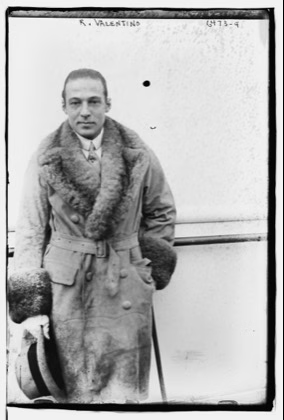
Valentino emigrated from Italy to New York in 1913 and worked menial jobs -- gardening, dishwashing, street sweeping -- before finding steadier work as a professional dance partner at venues including the Winter Garden Theatre. He moved into film with small, uncredited parts starting in 1916, gradually building toward his breakout leading roles in The Four Horsemen of the Apocalypse and The Sheik, both released in 1921, which made him the era's leading romantic idol.
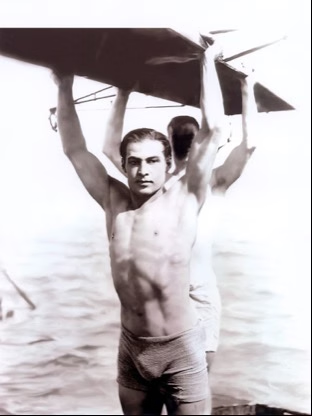
Later films included Blood and Sand (1922) and his final release, The Son of the Sheik (1926), but not every project succeeded: 1924's Monsieur Beaucaire underperformed after audiences reportedly found his costuming effeminate, part of a broader public tension over his image. That tension became explicit in July 1926, when a Chicago Tribune editorial blamed Valentino for the "feminization" of American men after a pink powder-puff vending machine was spotted in a men's washroom; Valentino publicly challenged the anonymous writer to a boxing match and defeated a sportswriter who stood in for him, refereed by heavyweight champion Jack Dempsey.
Marriages to Jean Acker and Natacha Rambova
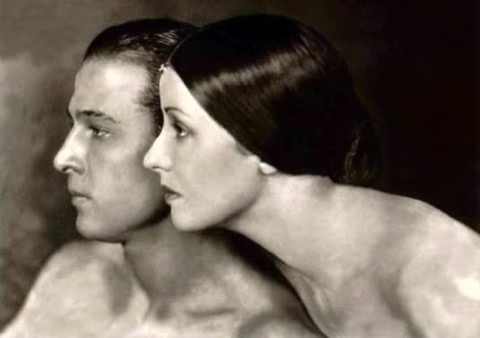
Valentino married actress Jean Acker in November 1919, but she locked him out of their hotel room on their wedding night and the marriage was never functional; it ended in divorce in January 1922. He married costume and set designer Natacha Rambova in 1922 and again, after a legal correction, in 1923. Rambova took an active role in shaping his career and image, to the point that later contracts barred her from his film sets; the couple separated in 1925 and divorced in early 1926. Valentino had no children from either marriage.
Death and the Funeral Riot
Valentino collapsed in pain at New York's Hotel Ambassador on August 15, 1926, and underwent emergency surgery for a ruptured gastric ulcer and appendicitis. He developed peritonitis and pleuritis and died on August 23, 1926, at age 31. His death set off scenes of mass public mourning rarely matched before or since: roughly 100,000 people lined the streets for his funeral at Frank Campbell's funeral home in New York, and a riot broke out among fans trying to view his open casket, smashing windows before mounted police restored order. He was buried at Hollywood Forever Cemetery in Los Angeles.
Frequently Asked Questions
How did Rudolph Valentino die?
He died of peritonitis on August 23, 1926, in New York, following surgery for a ruptured gastric ulcer and appendicitis, at age 31.
Was Rudolph Valentino wealthy when he died?
He earned a very high Hollywood salary by 1926 ($10,000 a week plus a profit percentage), but he also carried significant debts; his Beverly Hills estate, Falcon Lair, was auctioned off below its purchase price shortly after his death to help pay them.
Was Rudolph Valentino married?
Yes, twice: to actress Jean Acker (1919-1922) and to designer Natacha Rambova (1923-1926). He had no children.
What caused the riot at Valentino's funeral?
An estimated 100,000 mourners gathered in New York, and some tried to force their way into the funeral home to view his body, leading to smashed windows and a large police response before order was restored.