Andrew Carnegie's fortune peaked at roughly $480 million when he sold Carnegie Steel Company to J.P. Morgan in 1901 -- the deal that created U.S. Steel, the first billion-dollar company in American history. Adjusted for today's economy, historians have estimated his wealth at the time was equivalent to several hundred billion dollars in modern terms. What sets Carnegie apart from other Gilded Age tycoons is what he did next: he spent the last two decades of his life giving away nearly 90% of that fortune.
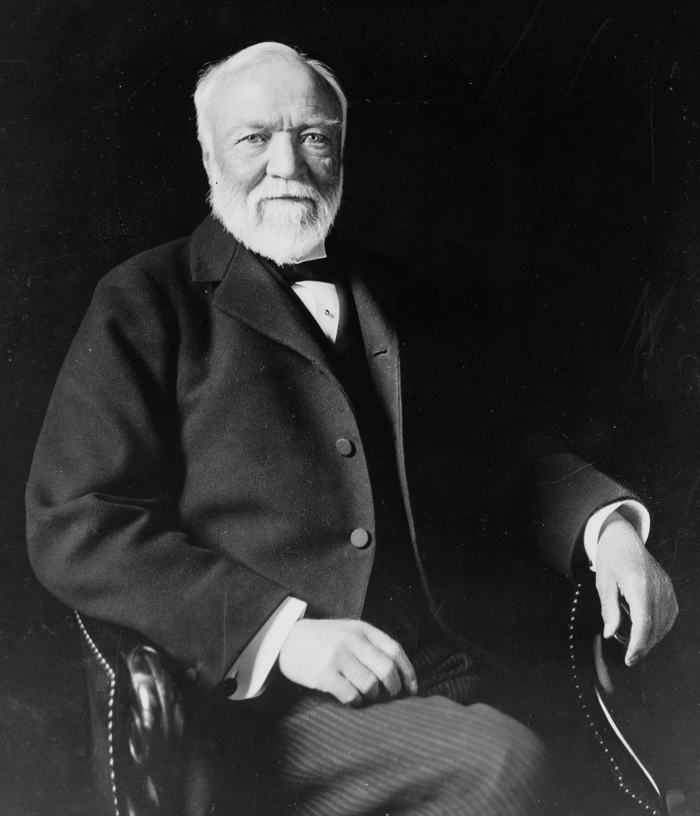
Quick Facts
| Full Name | Andrew Carnegie |
| Born | November 25, 1835, Dunfermline, Scotland |
| Died | August 11, 1919, Lenox, Massachusetts, age 83 |
| Known For | Founder of Carnegie Steel Company (1892) |
| 1901 Sale | Sold Carnegie Steel to J.P. Morgan for $480 million, forming U.S. Steel |
| Philanthropy | Gave away roughly $350 million (about 90% of his fortune), funding over 3,000 public libraries |
| Key Essay | "The Gospel of Wealth" (1889), arguing the rich have a duty to give away their fortunes |
Early Life and Immigration
Carnegie was born in Dunfermline, Scotland, to a weaver's family that fell into poverty as industrialization displaced hand-loom weaving. In 1848, at age 12, his family emigrated to Allegheny, Pennsylvania, where Carnegie took his first job as a bobbin boy in a cotton mill earning $1.20 a week. He worked his way up through a telegraph messenger job and then the Pennsylvania Railroad, becoming superintendent of its Western Division by 1859 -- experience that taught him the industrial-scale organization he would later apply to steel.
Building Carnegie Steel
Through the 1860s and 1870s, Carnegie invested profitably in railroads, bridges, and oil before turning his full attention to steel, acquiring the Homestead Steel Works in 1883 and consolidating his holdings as the Carnegie Steel Company in 1892. Using aggressive vertical integration -- controlling raw materials, transportation, and production all under one roof -- Carnegie Steel became the largest steel producer in the world by the late 1880s.
The 1901 Sale and U.S. Steel
In 1901, Carnegie sold Carnegie Steel to financier J.P. Morgan for $480 million, famously writing his asking price on a slip of paper for Morgan to accept outright. Morgan merged it with Federal Steel and other holdings to form the United States Steel Corporation, the world's first billion-dollar company. The sale made the by-then 65-year-old Carnegie one of the wealthiest people in the world and freed him to spend the rest of his life on philanthropy.
The Gospel of Wealth and Philanthropy
In an 1889 essay titled "The Gospel of Wealth," Carnegie argued that the rich have a moral obligation to distribute their fortunes for the public good during their own lifetimes rather than simply passing them to heirs. He put that philosophy into practice, giving away an estimated $350 million -- nearly 90% of his total wealth -- before his death. His giving funded more than 3,000 public libraries across English-speaking countries, the Carnegie Institution for Science (1902), Carnegie Hall (1891), Carnegie Mellon University, and the Carnegie Corporation of New York, which he established in 1911 to continue his philanthropic work after his death.
Personal Life
Carnegie married Louise Whitfield in 1887, when he was 51. They had one daughter, Margaret Carnegie Miller. He died of bronchopneumonia on August 11, 1919, at his estate in Lenox, Massachusetts.
Frequently Asked Questions
What was Andrew Carnegie's net worth?
His fortune peaked at around $480 million after selling Carnegie Steel to J.P. Morgan in 1901 -- a sum historians say would be worth several hundred billion dollars in today's economy relative to the size of the U.S. GDP at the time.
Why did Andrew Carnegie sell his steel company?
He sold Carnegie Steel to J.P. Morgan in 1901 to focus the rest of his life on philanthropy, having already decided that accumulating wealth without giving it away was, in his words, a disgrace.
How much of his fortune did Carnegie give away?
Roughly $350 million, or about 90% of his total wealth, funding more than 3,000 libraries and institutions including Carnegie Hall, Carnegie Mellon University, and the Carnegie Institution for Science.
Was Andrew Carnegie related to John D. Rockefeller?
No. They were not related and did not found a company together; Carnegie built his fortune in steel while Rockefeller built his in oil through the separate Standard Oil Company.