John D. Rockefeller's fortune peaked at around $900 million in 1913, equal to roughly 2.3% of the entire U.S. economy at the time -- a share of national wealth historians say no one has matched since, which is why his fortune is sometimes described in inflation-adjusted terms of $300-400 billion in today's dollars. He built it through Standard Oil, which controlled about 90% of American oil refining by 1900, before the U.S. Supreme Court broke the company into 34 separate firms in 1911 under the Sherman Antitrust Act.
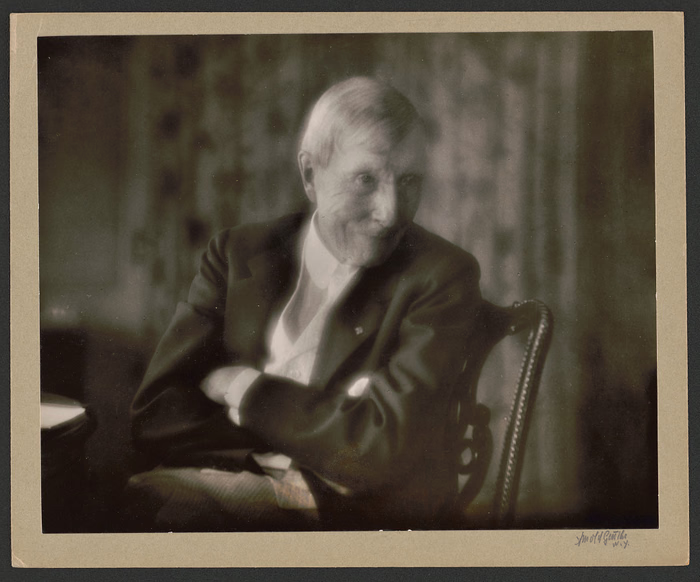
Quick Facts
| Full Name | John Davison Rockefeller |
| Born | July 8, 1839, Richford, New York |
| Died | May 23, 1937, Ormond Beach, Florida, age 97 |
| Known For | Founder of Standard Oil (1870); America's first billionaire (1916) |
| Peak Fortune | About $900 million in 1913, roughly 2.3% of U.S. GDP |
| 1911 Event | U.S. Supreme Court ordered Standard Oil broken into 34 separate companies for antitrust violations |
| Philanthropy | Roughly $530 million donated in his lifetime, including founding the Rockefeller Foundation (1913) and Rockefeller Institute for Medical Research (1901, now Rockefeller University) |
Early Life
Rockefeller was born in Richford, New York, to William Rockefeller, an itinerant salesman who styled himself a "botanic physician" and was known for shady dealings, and Eliza Davison, a devout Baptist whose values shaped him far more than his father's. He attended Owego Academy and Cleveland's Central High School, then completed a ten-week bookkeeping course at Folsom's Commercial College -- his only formal business training. At 16, in 1855, he took his first job as an assistant bookkeeper at a Cleveland produce firm, Hewitt & Tuttle, a modest start for a fortune that would eventually be the largest in American history.
Building Standard Oil
Rockefeller entered the oil refining business in 1863 and, after buying out his early partners in 1865, went on to found Standard Oil of Ohio on January 10, 1870, alongside Henry Flagler and Samuel Andrews. Through aggressive acquisition of competitors, favorable railroad shipping rebates, and tight cost control, Standard Oil came to control roughly 90% of U.S. oil refining capacity by 1900, making it one of the first and largest industrial trusts in American history -- and Rockefeller personally the wealthiest man in the country.
The 1911 Antitrust Breakup
Standard Oil's dominance drew sustained legal challenges, culminating in a 1911 U.S. Supreme Court ruling that the company violated the Sherman Antitrust Act and had to be dissolved into 34 independent companies -- corporate ancestors of firms including ExxonMobil, Chevron, and Marathon Petroleum. Ironically, the breakup made Rockefeller even richer on paper, since he held stock in all 34 successor companies and their combined value soon exceeded Standard Oil's pre-breakup worth. He became America's first billionaire on paper on September 28, 1916.
Philanthropy
In his later decades, Rockefeller gave away roughly $530 million, a scale of giving unprecedented at the time. He founded the Rockefeller Foundation in 1913, donated roughly $80 million to help found and build the University of Chicago, and established the Rockefeller Institute for Medical Research in 1901, which was renamed Rockefeller University in 1965 and remains a leading biomedical research center. He also founded the General Education Board in 1903 and funded Spelman College, named for his wife's family.
Personal Life
Rockefeller married Laura Celestia "Cettie" Spelman in 1864. They had five children, including John D. Rockefeller Jr., who went on to continue the family's philanthropic and business legacy.
Frequently Asked Questions
What was John D. Rockefeller's net worth?
His fortune peaked at around $900 million in 1913, equal to about 2.3% of U.S. GDP -- a share of the national economy often cited by historians as equivalent to $300-400 billion today.
Why was Standard Oil broken up?
In 1911, the U.S. Supreme Court ruled it violated the Sherman Antitrust Act and ordered it split into 34 separate companies.
Was John D. Rockefeller really the first billionaire?
Yes, by most historical accounts he became the first person in the U.S. with a paper net worth exceeding $1 billion, on September 28, 1916.
What did Rockefeller do with his fortune?
He gave away roughly $530 million during his lifetime, founding the Rockefeller Foundation, the Rockefeller Institute for Medical Research (now Rockefeller University), and helping establish the University of Chicago.