Alvin Leung's net worth is not publicly verified. No reliable source publishes a complete list of his assets, restaurant equity, investments and debts. Precise figures repeated by entertainment profiles cannot be reproduced from public records, so they should not be presented as calculations.
What is verifiable is substantial: Leung is the owner-chef of two-MICHELIN-starred Bo Innovation, was an original MasterChef Canada judge, co-owns Toronto restaurant R&D with Eric Chong, and partnered with Chong on one-MICHELIN-starred aKin. Those achievements identify his likely income sources, but they do not reveal his personal net worth.
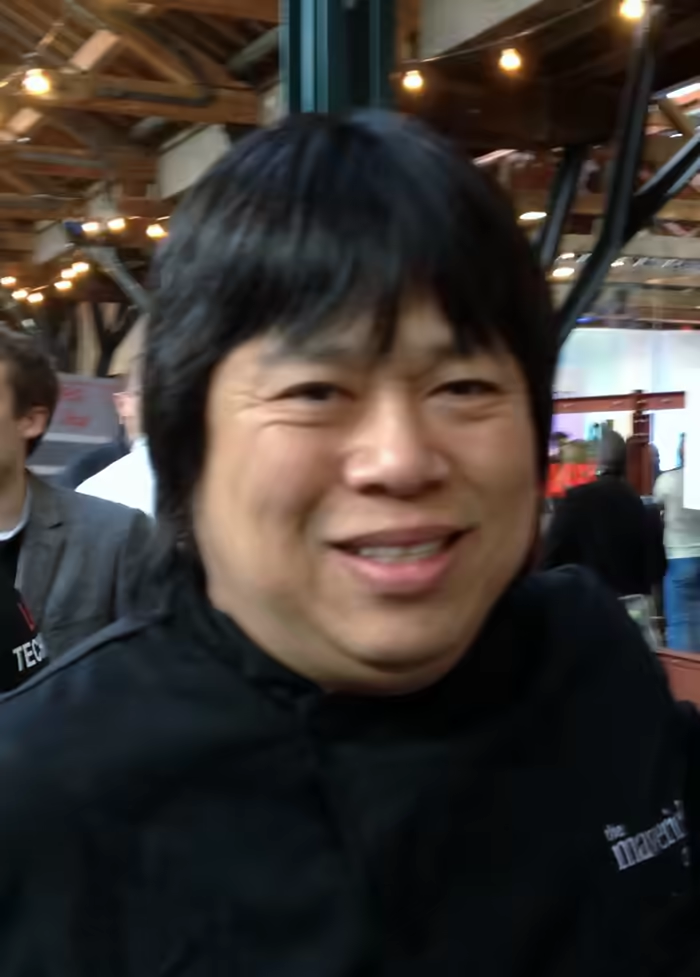

Alvin Leung Quick Facts
| Question | Evidence-based answer |
|---|---|
| Who is Alvin Leung? | A Canadian chef, restaurateur and television judge known as the Demon Chef |
| Net worth | Not publicly verified |
| Known for | Bo Innovation, X-Treme Chinese cuisine and MasterChef Canada |
| Current Michelin recognition | Bo Innovation has two MICHELIN Stars; aKin has one |
| Toronto partnership | R&D and aKin with chef Eric Chong |
| Career before cooking | Professionally trained engineer |
| Birthplace | London, England; he grew up in Scarborough, Ontario |
| Exact restaurant ownership stakes | Not publicly disclosed |
| Television salary | Not publicly disclosed |
Why There Is No Defensible Alvin Leung Net Worth Figure
Net worth means assets minus liabilities. A credible calculation for Leung would therefore need the value of his restaurant interests, property, cash and investments, less mortgages, business debt, taxes and other obligations. The public sources reviewed for this profile do not provide those numbers.
Michelin can verify a restaurant's distinction and identify an owner-chef. Bell Media can verify a television role and a restaurant partnership. Neither source publishes Leung's ownership percentage, distributions, salary, production contract, personal expenses or liabilities. Without those inputs, assigning a precise dollar total creates confidence that the evidence does not support.
This distinction matters especially in hospitality. Restaurant sales are not the owner's take-home income. Revenue must cover ingredients, payroll, rent, equipment, taxes, financing and partner shares. A celebrated restaurant may strengthen a chef's brand while still revealing almost nothing about the chef's personal balance sheet.
Bo Innovation and the Demon Chef Brand
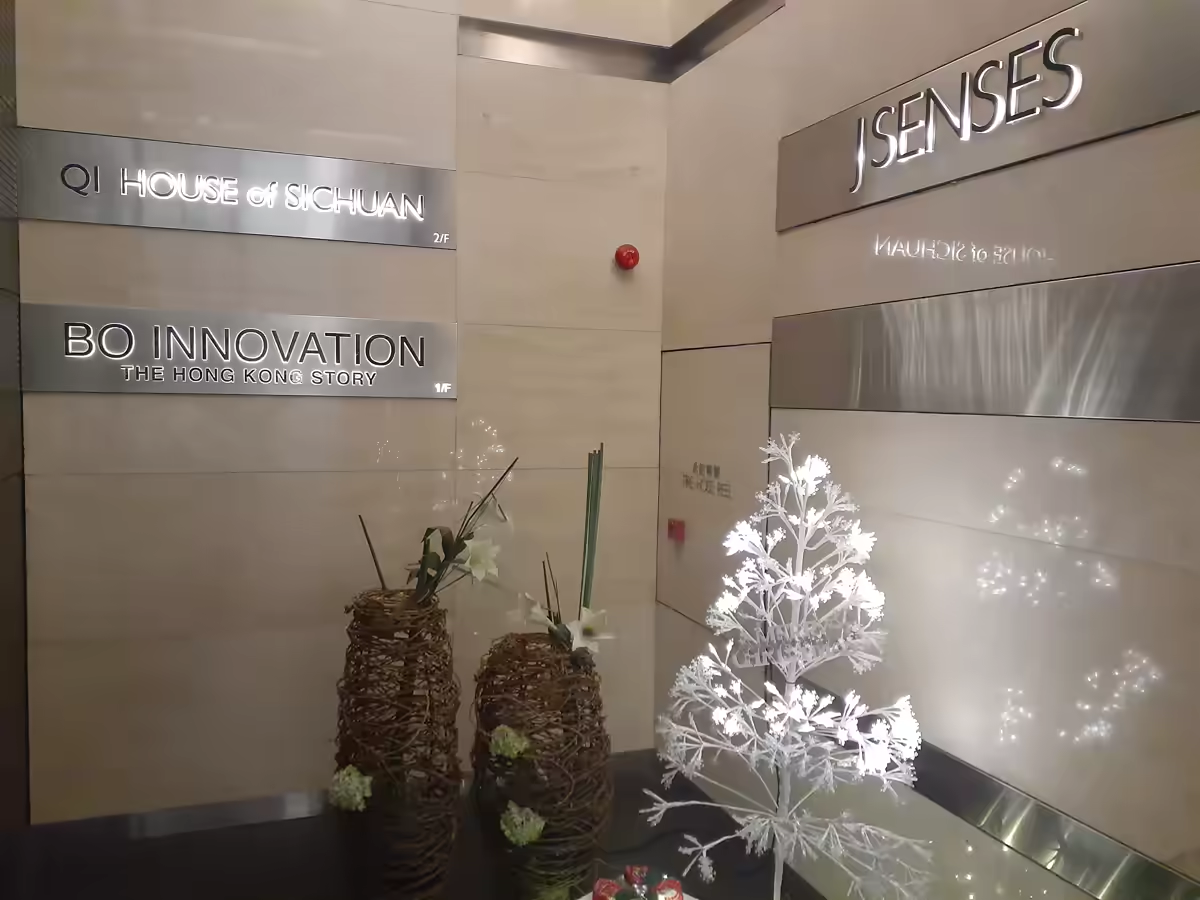
The MICHELIN Guide's current Bo Innovation listing identifies Leung as its owner-chef and awards the Hong Kong restaurant two MICHELIN Stars. The guide describes a single dinner tasting menu built around playful references to Hong Kong food culture and notes that Leung moved the restaurant to its present Central location in 2022.
Leung's Michelin history began much earlier. In a MICHELIN Guide interview about his career, he said he entered the restaurant business as a busboy at 16, later worked in engineering, and accepted an opportunity to become a partner in the struggling Bo Innoseki private kitchen in 2003. He recalled Bo Innovation receiving two stars in 2009 and discussed the work required to regain and maintain recognition after its rating changed.
The same interview explains the substance behind the Demon Chef persona. Leung describes innovation, rather than shock alone, as his guiding idea and says his inspiration comes through the five senses and everyday life. Michelin now characterizes his approach as “X-Treme Chinese”: Chinese culinary ideas broken down and reinterpreted through modern technique.
Bo Innovation is therefore the strongest public evidence of Leung's long-term commercial and professional standing. It is not evidence that he personally owns the restaurant's gross revenue, nor does its star count supply a valuation for his stake.

Do Michelin stars reveal a chef's earnings?
No. MICHELIN Stars assess the cooking at a restaurant; they are not financial ratings and do not disclose revenue, profit or an owner's wealth. Michelin describes one star as high-quality cooking, two as excellent cooking worth a detour, and three as exceptional cuisine worth a special journey. The award belongs to the restaurant's current culinary performance rather than functioning as a price tag for the chef.
A distinction can create commercial advantages. It may support demand, media attention, event invitations and a chef's ability to launch other projects. It can also bring higher expectations and operating costs. Leung told Michelin that the best part of owning Michelin-starred restaurants was the advertising, while the worst was competitors trying to recruit his staff. That is useful business context, but it still supplies no dollar value for his personal ownership.
The safe conclusion is limited: Michelin recognition helped establish Leung's international reputation. Converting that reputation into a personal net-worth figure would require financial records that Michelin does not collect or publish.
R&D and aKin with Eric Chong
Leung's Toronto restaurant story grew from television. Bell Media records show that he judged Eric Chong the winner of the first MasterChef Canada season. A later Bell Media report on a restaurant-takeover episode identifies Leung and Chong as co-owners of R&D.
MICHELIN's R&D listing classifies the Toronto restaurant as a Bib Gourmand and describes the partnership between the former judge and winner. Bib Gourmand is Michelin's recognition for good-quality, good-value cooking; it is distinct from a MICHELIN Star.
The partnership later produced aKin. In its profile of Eric Chong as the 2025 Toronto Young Chef Award winner, Michelin calls aKin their latest restaurant partnership and identifies it as a one-MICHELIN-starred tasting-menu restaurant. That source supports Leung's involvement and the restaurant's recognition, but it does not disclose either partner's investment, equity percentage or earnings.
MasterChef Canada and Television Income
Bell Media announced Leung, Michael Bonacini and Claudio Aprile as the original MasterChef Canada judges in September 2013, ahead of the show's 2014 launch. Its official judges announcement described Leung as a professionally trained engineer, the owner of Bo Innovation, and a London-born chef who grew up in Scarborough.
Leung remained part of the judging trio through MasterChef Canada: Back to Win. Bell Media's coverage of that season confirms that he judged alongside Bonacini and Aprile. Television clearly expanded his public profile and connected him with Chong, but Bell Media does not publish his appearance fee, per-season salary, residuals or other contract terms.
It is reasonable to identify TV as an income stream. It is not reasonable to invent its value. The same rule applies to guest appearances, event fees, endorsements and consulting: a public credit can establish that work occurred, but it cannot establish the payment.
Engineering Background and Route into Cooking
Leung did not follow a conventional culinary-school path. Bell Media describes him as a professionally trained engineer, while Michelin calls him self-taught as a chef. In Michelin's interview, Leung explains that family obligations initially took him into the engineering business before an opportunity brought him back to restaurants.
That history is relevant because it helps explain his public cooking identity: systematic, experimental and intentionally disruptive. It also corrects a common oversimplification. He was not an overnight television creation; he had an engineering career, entered the Hong Kong restaurant business in 2003, and built years of culinary recognition before MasterChef Canada.
What Alvin Leung's Career Can—and Cannot—Tell Us About Wealth
Leung's career supports four careful conclusions:
- He has built a durable chef brand around Bo Innovation and the Demon Chef identity.
- He has participated in restaurant ventures in more than one market, including documented partnerships in Toronto.
- He gained a separate television platform through MasterChef Canada.
- His private financial inputs remain undisclosed, preventing a reliable net-worth calculation.
It does not follow that every restaurant associated with Leung is wholly owned by him, that every Michelin distinction creates a fixed amount of personal wealth, or that a television role carries a publicly knowable salary. Those assumptions are precisely why celebrity net-worth pages often disagree.
How This Profile Was Verified
This page prioritizes direct records from the MICHELIN Guide and Bell Media. Michelin is used for restaurant status, ownership descriptions and its interview with Leung. Bell Media is used for the MasterChef Canada judging role and the documented R&D partnership. No net-worth aggregator is used to establish a dollar amount.
SuccessTitan found no authoritative disclosure of Leung's assets and liabilities, so it does not publish a range. If a future company filing, court record, property record or direct financial disclosure supplies verifiable figures, the estimate can be revisited with those inputs shown.
Related Business and Restaurant Profiles
Readers interested in restaurant businesses can compare Leung's evidence with profiles of restaurateur Richard Sandoval, McDonald's founders Dick McDonald and Ray Kroc, former McDonald's executive Harry Sonneborn, and food-and-media entrepreneur Martha Stewart. Public-company filings and documented transactions can make some business fortunes easier to analyze; a privately held restaurant career usually provides fewer usable financial inputs.
Bottom Line
Alvin Leung's net worth remains unknown from public evidence. His two-star Bo Innovation, Toronto partnerships, one-star aKin connection and long television role establish a significant international career. They do not establish a personal balance sheet. The most accurate answer is therefore not a recycled $10 million figure, but a transparent account of what the available records can prove.