Henry Ford's fortune was estimated at $188 million to $200 million at his death in 1947 -- a sum some historians describe as equivalent to well over $100 billion in modern terms when measured as a share of the U.S. economy, since Ford Motor Company was privately held and its stock never traded publicly during his lifetime. He built that fortune on the Model T and the moving assembly line, but his legacy also includes a well-documented antisemitic publishing campaign that remains part of the historical record.
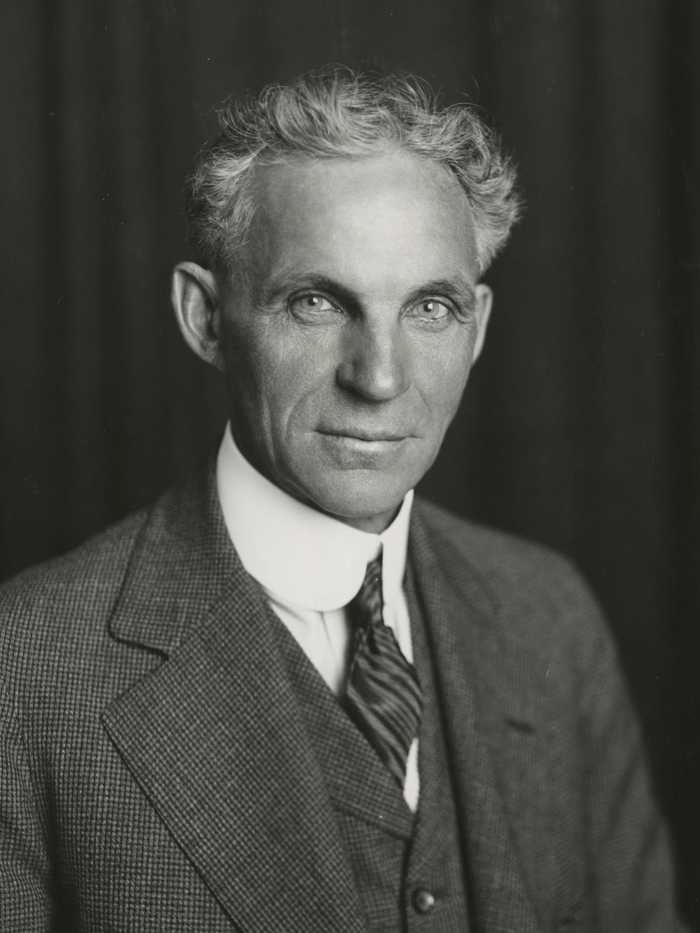
Quick Facts
| Full Name | Henry Ford |
| Born | July 30, 1863, Greenfield Township, Michigan |
| Died | April 7, 1947, Dearborn, Michigan, age 83 |
| Known For | Founder of Ford Motor Company (1903); the Model T; the moving assembly line (1913) |
| 1914 Milestone | Doubled factory wages to $5 a day, a widely covered move at the time |
| Fortune at Death | $188 million to $200 million (1947 dollars) |
| Documented Legacy Issue | Published antisemitic material through The Dearborn Independent and "The International Jew" in the 1920s; received a Nazi Germany medal in 1938 |
Early Life
Ford was born in Greenfield Township, Michigan, to William Ford, an Irish immigrant farmer, and Mary Litogot Ford. He completed only an eighth-grade education and never attended high school, later taking a bookkeeping course at a commercial school. In 1879, he apprenticed as a machinist in Detroit, and by 1891 he was working as an engineer for the Edison Illuminating Company, rising to chief engineer by 1893 -- a role that gave him the technical grounding and some of the capital he needed to experiment with gasoline engines on the side.
Ford Motor Company and the Model T
Ford founded the Ford Motor Company on June 16, 1903, with $28,000 in capital. The company introduced the Model T on October 1, 1908, and in 1913 implemented the moving assembly line, which dramatically cut production time and cost, making car ownership realistic for ordinary American households for the first time. On January 5, 1914, Ford more than doubled the prevailing factory wage to $5 a day, a move that drew national attention and helped stabilize his workforce, and in 1926 the company adopted a five-day workweek, ahead of most American industry.
Antisemitism and Historical Legacy
Ford's legacy is inseparable from a well-documented antisemitic campaign he personally funded and directed. After purchasing the newspaper The Dearborn Independent in 1918, he used it starting in 1920 to publish a 91-issue series of antisemitic articles, later compiled and distributed as the pamphlet "The International Jew," which sold more than 500,000 copies across the United States and Europe. He closed the paper in December 1927 after a libel lawsuit brought by Aaron Sapiro, but the material continued to circulate internationally for years. In July 1938, Nazi Germany awarded Ford the Grand Cross of the German Eagle, one of the highest honors the regime gave to foreigners. These facts are part of the standard historical record on Ford and are addressed directly by his own company and by Holocaust-history institutions today.
Personal Life
Ford married Clara Jane Bryant in 1888. Their only child, Edsel Ford, later served as president of Ford Motor Company until his death in 1943.
Frequently Asked Questions
What was Henry Ford's net worth?
His fortune was estimated at $188 million to $200 million at his death in 1947, a sum some historians equate to well over $100 billion in modern terms given the size of the privately held company he controlled.
Did Henry Ford invent the assembly line?
He didn't invent the general concept, but his company's 1913 moving assembly line for automobile production was a transformative refinement that made the Model T affordable at unprecedented scale.
Was Henry Ford antisemitic?
Yes. He personally funded and directed an antisemitic publishing campaign through The Dearborn Independent and "The International Jew" in the 1920s and received a Nazi German honor in 1938 -- a well-documented part of his historical legacy.
What was the $5 workday?
A January 1914 policy that more than doubled Ford factory workers' wages, widely covered at the time as a dramatic and influential labor decision.